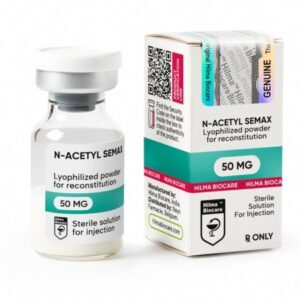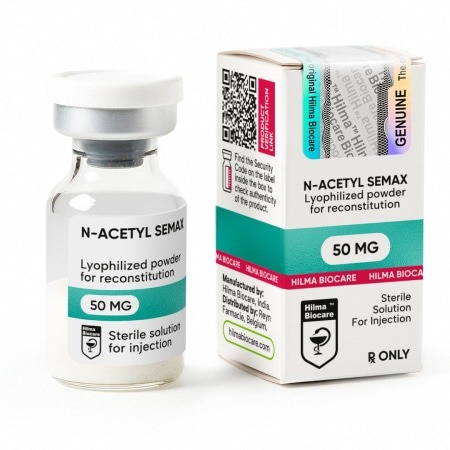
N-Acetyl Semax: 7 Facts About Research, Potential Benefits, and Safety
N-Acetyl Semax is a chemically modified version of Semax, a synthetic peptide investigated for its potential effects on neurological processes. Semax has been studied in areas such as cognitive function and recovery following certain neurological injuries. However, research involving regular Semax cannot automatically establish the safety or effectiveness of its modified form. Published information specifically about N-Acetyl Semax remains extremely limited. Source: compound research overview
Interest in N-Acetyl Semax has grown in discussions about cognitive performance, focus, memory, and neuroprotection. Despite these claims, it is important to distinguish scientific evidence from marketing statements. Understanding its chemical background, research limitations, and potential safety concerns helps readers make more informed decisions.
1. What Is N-Acetyl Semax?
N-Acetyl Semax is a modified peptide derived from Semax. Semax itself is a synthetic peptide related to a fragment of adrenocorticotropic hormone (ACTH), a hormone involved in the body’s stress-response system.
The term N-acetyl indicates a chemical modification at the peptide’s amino-terminal end. Some products marketed under similar names also include a second modification called C-terminal amidation. These modifications can change a molecule’s chemical properties, but their effects on biological activity must be demonstrated experimentally.
It is therefore important to verify the precise chemical identity of any product labelled N-Acetyl Semax. Different modifications should not be treated as interchangeable, and a product name alone does not establish purity, potency, or pharmaceutical quality.
2. How Does N-Acetyl Semax Work?
The precise biological effects of N-Acetyl Semax have not been adequately established in published research. Proposed explanations are often based on findings involving the parent compound, Semax, rather than direct studies of the modified peptide.
Research on Semax has explored its relationship with neurotrophic signaling pathways, including pathways associated with brain-derived neurotrophic factor (BDNF). These signaling systems are involved in neuronal function, adaptation, and responses to injury.
However, it would be inaccurate to assume that N-Acetyl Semax produces the same effects, has the same duration of action, or behaves identically in the human body. Chemical modifications can affect stability, absorption, distribution, and biological activity. Dedicated pharmacological research is needed to establish these characteristics.
3. What Are the Proposed Benefits?
N-Acetyl Semax is discussed online in connection with several potential cognitive and neurological effects. Common claims include:
- Supporting attention and concentration
- Influencing memory-related processes
- Supporting neurological research
- Affecting pathways involved in neuronal signaling
- Potentially changing the stability of the parent peptide
These claims should be interpreted cautiously. They are not established clinical benefits of N-Acetyl Semax, and there is insufficient direct evidence to confirm that it improves cognition or protects the human brain.
Evidence concerning regular Semax may help researchers formulate questions about related compounds, but it cannot substitute for studies of the specific modified molecule. Claims about superior potency, longer-lasting effects, or improved cognitive performance require direct experimental and clinical confirmation.
4. What Does the Scientific Evidence Show?
The evidence for N-Acetyl Semax is a major limitation. Available compound-specific research summaries report no established body of human clinical trials demonstrating its effectiveness and safety. Evidence for the parent compound is not equivalent to evidence for the acetylated derivative. Research overview
Some research involving regular Semax has examined neurological conditions and cognitive processes, particularly in Russian clinical and research settings. These findings must be evaluated according to study design, sample size, outcome measures, and independent replication.
For N-Acetyl Semax, important unanswered questions include how the compound behaves in the body, whether it reaches relevant tissues, what biological targets it affects, and whether any potential effects translate into meaningful clinical outcomes.
Until appropriate studies address these questions, it is not possible to make reliable claims about its effectiveness for memory, focus, neurological recovery, or other medical purposes.
5. Potential Side Effects and Safety Concerns
The safety profile of N-Acetyl Semax has not been adequately characterized. A lack of published adverse-event reports does not prove that a substance is safe; it may instead reflect a lack of systematic testing or documented human exposure.
Potential concerns include unknown biological effects, allergic reactions, contamination, incorrect ingredient concentrations, and impurities introduced during manufacturing. Products intended for research use may not meet the same manufacturing and quality standards as authorized medicines.
For products marketed as nasal formulations, additional concerns may include irritation or damage related to the formulation or its ingredients. For injectable products, sterility, endotoxin contamination, and injection-related complications are important risks. These are general risks associated with unverified products and routes of administration, not a confirmed list of N-Acetyl Semax-specific adverse effects.
Anyone experiencing a suspected reaction should stop using the product and seek appropriate medical advice. Severe symptoms, including difficulty breathing or signs of a serious allergic reaction, require emergency care.
6. How Is N-Acetyl Semax Different From Semax?
The primary distinction is chemical structure. Regular Semax is the parent peptide, while N-Acetyl Semax incorporates an acetyl modification. Some products described by similar names also include amidation, which changes the peptide’s terminal structure.
Such modifications are sometimes explored in peptide chemistry because they may influence susceptibility to enzymatic breakdown or other chemical properties. However, a theoretical change in stability does not automatically mean a substance is more effective, safer, or longer-lasting in humans.
The distinction also matters when interpreting regulatory information. Authorization for one specific medicine does not automatically extend to a chemically modified derivative. Readers should verify the exact substance and applicable local requirements instead of relying on claims made about the parent peptide.
7. Product Quality, Regulation, and Responsible Research
Before considering a product labelled N-Acetyl Semax, verify its chemical identity, manufacturer, analytical documentation, and regulatory status. Certificates of analysis may provide information about identity and purity, but they do not independently demonstrate clinical safety or effectiveness.
In the United States, N-Acetyl Semax should not be assumed to be an FDA-approved medicine. Regulatory status varies by substance and jurisdiction, and any authorization associated with regular Semax should not be presumed to cover its modified forms.
Avoid products making guaranteed claims about intelligence, memory enhancement, neurological recovery, or superior potency without reliable supporting evidence. A supplier’s description or customer testimonial is not a substitute for controlled research.
People considering treatment for memory difficulties, attention problems, or neurological symptoms should consult a qualified healthcare professional. Evidence-based assessment can help identify underlying causes and determine which established options may be appropriate.
Frequently Asked Questions About N-Acetyl Semax
What is N-Acetyl Semax?
It is a chemically modified peptide derived from Semax. Its specific biological effects and clinical usefulness remain insufficiently established.
Does N-Acetyl Semax improve memory or focus?
There is insufficient direct clinical evidence to confirm that it improves memory or focus in humans.
Is N-Acetyl Semax the same as regular Semax?
No. The chemical structure differs, so findings involving regular Semax cannot automatically be applied to N-Acetyl Semax.
Is N-Acetyl Semax approved as a medicine?
Do not assume it is an approved medicine. Check the current regulatory status in your country and distinguish the modified compound from the parent peptide.
Conclusion
N-Acetyl Semax is a modified peptide that has attracted interest because of research involving its parent compound, Semax. However, its proposed cognitive benefits, biological activity, and safety profile remain insufficiently established. More compound-specific research is needed before reliable conclusions can be made about its use in humans.
Medical disclaimer: This article is for educational purposes only and is not a substitute for professional medical advice, diagnosis, or treatment. N-Acetyl Semax should not be regarded as an established treatment for cognitive or neurological conditions without appropriate clinical evidence and regulatory authorization.