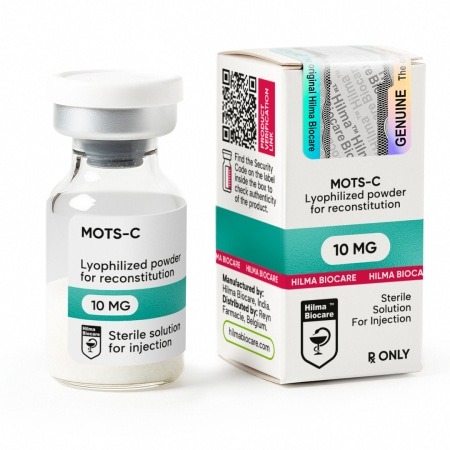
MOTS-C: 7 Important Facts About Mitochondrial Research and Safety
Introduction
MOTS-C is a small peptide encoded by mitochondrial DNA that has attracted scientific interest because of its potential role in cellular metabolism, insulin sensitivity, and responses to metabolic stress. Unlike many peptides encoded by nuclear DNA, MOTS-C originates from a short open reading frame within the mitochondrial genome.
Researchers are investigating how MOTS-C may communicate between mitochondria and other parts of the cell, potentially influencing metabolic processes and cellular responses to stress. These findings have generated interest in its possible relevance to exercise, aging, and metabolic health.
However, MOTS-C remains an experimental research peptide, and many claims made about its benefits have not been established in human clinical trials. This guide explains what MOTS-C is, how it is studied, its potential applications, and important safety considerations.
1. What Is MOTS-C?
It stands for mitochondrial open reading frame of the 12S rRNA-c. It is a short peptide associated with mitochondrial DNA and is studied as part of the broader field of mitochondrial-derived peptides.
Mitochondria are structures inside cells that play essential roles in energy production and metabolic regulation. Researchers have discovered that mitochondria may also produce small peptides that participate in signaling processes beyond their traditional energy-related functions.
This has been investigated for its potential involvement in glucose metabolism, cellular stress responses, and metabolic regulation. Nevertheless, its biological effects are still being studied, and its potential therapeutic applications remain uncertain.
Products marketed online as it should not be confused with approved medicines or established treatments.
2. How Does MOTS-C Work?
Research suggests that it may influence pathways involved in cellular metabolism and the way cells respond to metabolic stress.
In laboratory and animal studies, MOTS-C has been associated with changes in pathways related to energy balance and insulin sensitivity. Some research has also examined its relationship with AMPK, a protein that helps regulate cellular energy status.
Scientists are investigating whether MOTS-C can affect communication between mitochondria and the cell nucleus, potentially influencing how cells adapt to changing energy demands.
These mechanisms remain areas of active research. Findings from laboratory experiments or animals cannot establish that it will produce the same effects in humans or that taking a manufactured version of the peptide will improve health.
3. Potential Research Applications of MOTS-C
MOTS-C is being investigated in several areas of metabolic and cellular biology.
Metabolic health
Preclinical research has explored whether MOTS-C may influence glucose regulation and metabolic processes. Its possible role in insulin sensitivity is of particular interest, but it is not an established treatment for diabetes or insulin resistance.
Mitochondrial function
Because this is associated with mitochondrial biology, researchers are examining its potential involvement in energy regulation and cellular adaptation. This does not mean that supplementation has been shown to improve mitochondrial function in humans.
Exercise and physical performance
Some experimental research has investigated it in relation to exercise-associated metabolic responses. Claims that it reliably increases endurance, strength, or recovery in people remain unproven.
Aging research
Researchers are studying mitochondrial-derived peptides as part of broader investigations into aging and metabolic changes over time. Most has not been demonstrated to extend human lifespan or reverse aging.
These areas describe scientific research directions rather than confirmed clinical benefits.
4. What Does the Evidence Say About MOTS-C?
Much of the interest in it comes from laboratory studies and animal experiments. Such research can help scientists understand biological mechanisms and identify questions for future clinical trials.
However, evidence from preclinical research has important limitations. A peptide may produce a measurable effect in cells or animals without providing a safe or meaningful benefit in humans.
For it, there is not sufficient high-quality human clinical evidence to establish its effectiveness for weight management, diabetes, athletic performance, longevity, or general wellness.
Commercial testimonials and claims made by peptide suppliers are not substitutes for controlled clinical studies. Research findings should be evaluated according to the study design, number of participants, measured outcomes, and whether results have been independently replicated.
Further research is needed to determine it’s effects in humans, including its safety, pharmacology, and potential therapeutic applications.
5. MOTS-C Side Effects and Safety Considerations
The complete safety profile of this in humans has not been established. Limited clinical evidence means that both short-term and long-term risks may remain uncertain.
Important considerations include:
- Unknown adverse effects: The full range and frequency of possible side effects are not well characterized.
- Uncertain long-term safety: There is insufficient evidence to establish the consequences of prolonged exposure.
- Product quality: Unregulated products may contain impurities, incorrect concentrations, or substances not listed on the label.
- Injection-related risks: Injectable products can cause local reactions and may introduce infection or other complications if improperly prepared or administered.
- Medical conditions and medications: Potential interactions and effects in people with underlying health conditions require further investigation.
A peptide being naturally associated with the body does not guarantee that a manufactured product is safe. Research-grade material is not necessarily suitable for human use.
Anyone considering an experimental peptide should discuss the uncertainties with a qualified healthcare professional rather than relying on online marketing or informal dosing advice.
6. Is MOTS-C Approved for Human Use?
This is primarily discussed as an experimental research peptide and is not an established, generally approved treatment for metabolic disease, weight loss, exercise enhancement, or anti-aging.
Regulatory status can vary by country and product category. Research chemicals sold online may not have undergone the quality, safety, and efficacy assessments required for approved medicines.
Consumers should check the relevant national medicines regulator for current information and should not assume that a product is safe or authorized because a website describes it as pharmaceutical-grade or suitable for research.
For a medical condition such as diabetes or a metabolic disorder, evidence-based care and approved treatment options remain preferable to unproven peptide products.
7. Who Should Consider MOTS-C?
There is currently insufficient clinical evidence to recommend it as a routine supplement or general wellness treatment.
People interested in metabolic health, exercise performance, or healthy aging should distinguish established interventions from experimental approaches. A healthcare professional can help assess individual goals, identify underlying medical concerns, and discuss treatments supported by clinical evidence.
Researchers may investigate it under appropriate laboratory or authorized clinical-study conditions. Participation in a properly reviewed clinical trial is different from self-experimentation with a product obtained online.
Until better human evidence becomes available, claims that is reliably improves insulin sensitivity, builds muscle, burns fat, or extends lifespan should be treated cautiously.
Frequently Asked Questions About MOTS-C
What is MOTS-C peptide?
This is a short mitochondrial-derived peptide studied for its possible role in cellular metabolism, energy regulation, and metabolic stress responses.
What are the potential benefits of MOTS-C?
Research has explored metabolic regulation, insulin sensitivity, exercise-related responses, and aging biology. These are investigational areas, not established benefits for people.
Does MOTS-C help with weight loss?
There is insufficient high-quality human clinical evidence to establish it as a safe and effective weight-loss treatment.
Does MOTS-C improve exercise performance?
Some preclinical research has examined exercise-related metabolic responses, but MOTS-C has not been proven to reliably improve human endurance, strength, or recovery.
Is MOTS-C an anti-aging peptide?
This is being studied in relation to mitochondrial function and aging. It has not been demonstrated to reverse human aging or extend lifespan.
Is MOTS-C safe?
Its complete safety profile in humans is unknown. Product purity, possible adverse effects, and long-term risks are important concerns, especially for unregulated injectable products.
Is MOTS-C the same as SS-31?
No. This and SS-31 are different peptides with different research backgrounds. MOTS-C is a mitochondrial-derived peptide, while SS-31, also known as elamipretide, is a synthetic mitochondria-targeting peptide.
Conclusion
This is an emerging subject in mitochondrial and metabolic research. Early experimental findings have encouraged scientists to investigate its possible role in cellular energy regulation, insulin sensitivity, exercise-related responses, and aging biology.
However, its potential benefits in humans remain uncertain, and it should not be presented as a proven treatment for weight loss, diabetes, performance enhancement, or longevity. More rigorous clinical research is needed to establish its effectiveness and safety.
Medical disclaimer: This article is for educational and SEO purposes only. It does not provide medical advice, establish a treatment recommendation, or replace consultation with a qualified healthcare professional.